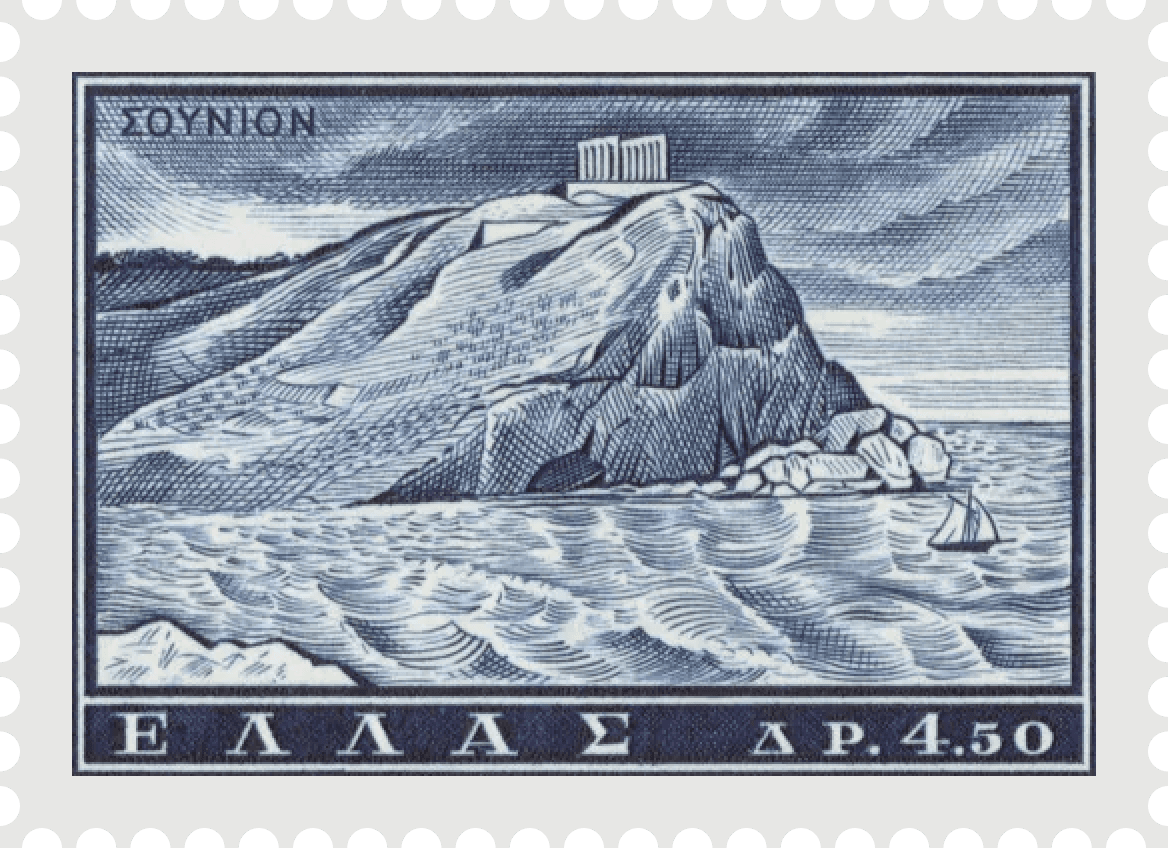
Temple of Poseidon, Cape Sounion
Issued by Hellenic Post
The stamp depicts the ancient Temple of Poseidon at Cape Sounion, constructed around 440 BC during the Golden Age of Athens under Pericles. Perched high on the rugged cliff cliffs at the southernmost tip of the Attica peninsula, the classical Doric temple overlooks the Aegean Sea on three sides. The design highlights the stark, standing marble columns set against the open sky and surrounding landscape.
Released as part of a landmark 17-stamp "Tourist Publicity" set issued by the Greek post office in February 1961 to promote international tourism, showcasing Greece's most famous ancient monuments and natural landscapes (such as the Acropolis, Delphi, Olympia, Mount Athos, Santorini, and Knossos).
Cape Sounion is legendary in Greek mythology as the headland where King Aegeus waited for his son Theseus returning from Crete. Misunderstanding a signal on Theseus' ship, Aegeus threw himself into the waters below, giving the Aegean Sea its name.
The designer, A. Tassos, created many of modern Greece's most celebrated postage stamps and bank notes, utilizing clean, high-contrast line engraving that became iconic in mid-century Greek philately.
- Designer
- A. Tassos
- Printer
- Aspiotis-ELKA Graphic Arts Co. Ltd.
- Printing method
- Line Engraving / Intaglio
- Approach
- Engraving
- Palette